TikTok Video Ideas
A hundred formats to film this week, and how to pick the TikTok video ideas that will go viral in your niche.
Published September 30, 2026 · Updated September 30, 2026 · 11 min read
Running out of TikTok video ideas is less about creativity than about format. Most accounts that post every day reuse a handful of shapes, such as a list, a reaction or a tutorial, and change the topic. This guide gives you 100 of those shapes, grouped for beginners, for accounts that never show a face, and for ten common niches. Each one is a starting point: add your subject, your product or your own story.
At the end you will find how to turn any idea into a script with a hook, a body and a call to action, and three free and paid tools that show what people in your niche are searching for and watching right now.
Find Out Why a TikTok Went Viral
Paste a TikTok link and see its hook, structure and call to action before you make your own version.
TikTok Ideas for Beginners
These formats need a phone and nothing else. None of them depends on a large audience, because TikTok's help pages say recommendations are built from what each viewer watches and interacts with, not only from who follows you.
- Answer one question you get asked all the time. Say the question on screen, answer in under 30 seconds.
- Show a before and after. A room, a recipe, a spreadsheet, a haircut.
- "Three things I wish I knew" about your job or hobby.
- A day in your life, in ten clips of three seconds each.
- Your honest review of something you bought this month.
- "Rate my setup": show your desk, kitchen or tools and invite comments.
- A mistake you made and what you do now instead.
- "How I would start over" in your field with what you know today.
- A myth in your niche and why it is wrong.
- Reply to a comment with a video. It gives you a topic and a viewer who already cares.
- A tiny tutorial: one tip, one result, no introduction.
- "What I spent / what I made" this week, if you are comfortable sharing it.
- Your first attempt versus your latest one.
- A list of tools you use every day, shown one by one.
- "Things that just make sense" in your niche.
- A reaction to a popular video in your niche, with your own take.
- A time-lapse of something that takes an hour.
- "Guess the price" of something you made or bought.
- A quick story: the weirdest request a customer ever made.
- "You are doing it wrong", followed by the right way in one step.
- An unboxing, with your first honest reaction.
- "Small things that improved my [routine]."
- A poll in the caption: which one would you choose?
- The same task done the cheap way and the expensive way.
- "Follow me for part two", but only if part two exists and you post it.
TikTok Video Ideas Without Showing Your Face
A faceless account is not a disadvantage if the picture carries the video. These formats put the result, your hands or your screen in front of the camera instead of you.
- Screen recording of a shortcut or trick in an app your audience uses.
- Hands-only cooking or crafting, filmed from above.
- A voiceover over stock-free footage you shot yourself, such as a walk or a commute.
- Text-on-screen stories: one sentence per clip, with music.
- Before-and-after with no narration.
- A tour of a place, filmed from your point of view.
- "Things in my bag / desk / car", one item per cut.
- Slideshow tips: five photo slides, one tip on each.
- ASMR-style process videos: cleaning, organising, restoring.
- Data visualised: a chart you made, explained in the caption.
- Reading and reacting to reviews of a product, with the text on screen.
- "Rate these": a series of items with a score on each.
- A quiz: the question on one clip, the answer on the next.
- Miniature or model building, sped up.
- Your pet, with a voiceover of what it is "thinking".
- Planner or journal set-ups.
- Coding or design in progress, with the finished result at the end.
- "Guess the song / place / year" from a clip.
- A step-by-step list written on paper, one line per shot.
- Satisfying fixes: a stuck lid, a tangled cable, a wobbly table.
- Photo dumps with a story in the captions.
- Street or nature sounds with a single line of text.
- Comparisons side by side: two products, two methods, two prices.
- A timer challenge: how much can you finish in 60 seconds?
- A "how it's made" of your own product, hands only.
Ideas by Niche
The same formats land differently in each niche. Here are five starting points for ten common ones.
Food: 51. a recipe in five ingredients; 52. one dish three ways; 53. "what I eat in a day" on a budget; 54. fixing a common cooking mistake; 55. rating store-bought versus homemade.
Fitness: 56. one exercise done right and wrong; 57. a workout with no equipment; 58. "what 30 days of this did for me"; 59. myths about a popular diet; 60. a warm-up in 60 seconds.
Beauty: 61. one product, three looks; 62. a routine for a specific problem; 63. testing a viral product honestly; 64. "cheap versus expensive" of the same item; 65. mistakes that make make-up look heavy.
Finance: 66. one money habit and what it saves; 67. explaining a term in 30 seconds; 68. "what I would do with my first paycheque"; 69. a budget template walkthrough; 70. a common scam and how to spot it.
Travel: 71. a place in five shots; 72. "what nobody tells you" about a city; 73. packing for a trip in one bag; 74. the cheapest way to do an expensive trip; 75. a local food you have to try.
Tech: 76. a hidden phone setting; 77. a gadget under a set price; 78. "apps I delete immediately"; 79. setting up a device from the box; 80. comparing two popular tools.
Small business: 81. packing an order; 82. how you price a product; 83. the story behind your brand name; 84. a customer question answered; 85. "a day running a one-person business".
Education: 86. one fact that surprises people; 87. a study method explained; 88. a common exam mistake; 89. a history story in 60 seconds; 90. "explain it like I'm ten".
Home and DIY: 91. a rental-friendly upgrade; 92. a fix for under a set price; 93. organising one drawer; 94. a tool every home needs; 95. a room transformation over a weekend.
Pets: 96. a training trick in three steps; 97. a product your pet loves or hates; 98. "things my dog does that make no sense"; 99. a vet question answered, with the vet's permission; 100. a first day at home with a new pet.
Choose the three that fit your account and film them this week. One video will not tell you much, but three versions of the same idea will.
Watch What Your Competitors Post
Add the accounts in your niche and get an email when one of their videos takes off.
How to Choose the Ideas Worth Filming
A list of 100 ideas is only useful if you can tell which five to film first. Four questions narrow it down quickly.
Is someone already searching for it? An idea that answers a question people type into TikTok's search bar starts with demand. TikTok's own Creator Search Insights shows which topics are searched often, and its content gap filter shows the ones searched often but covered by few videos. Those are the easiest wins for a small account.
Has a version of it worked for an account like yours? Look at the ten most-watched recent videos of three accounts in your niche that are about your size, or let TikTok competitor tracking flag their breakouts for you. If a format appears more than once, it is a format your audience already accepts.
Can you deliver the payoff in under 30 seconds? Short videos reward ideas with one clear result. If an idea needs a long setup, split it into a series and make each part stand on its own.
Will you still want to post about it next month? Consistency matters more than any single idea. Pick topics you can come back to with a new angle every week, so each video builds on the last one instead of starting from zero.
Score each idea from 0 to 2 on these four questions and film the top five. It takes ten minutes and saves you from filming ideas nobody was waiting for.
Keep a running list, too. Every time a comment asks a question, a competitor's video takes off or you catch yourself explaining something twice, write it down. After a month that list will be longer than this page, and every idea on it will be specific to your audience.
Using Trends Without Chasing Them
A trending sound or hashtag can carry a video further than it would go on its own, but only if it fits what your account is about. Joining every trend turns a food account into a random feed, and followers who came for recipes stop recognising it.
A simpler rule: use a trend when you can say something about your own niche with it. A popular sound becomes the backing track for your before-and-after; a challenge format becomes a way to show your product. TikTok's Creative Center lists the hashtags rising in your country this week, so you can check whether a trend is still growing before you spend an afternoon on it.
Trends also age fast. If you find one late, skip it and keep the format for later: the structure of a trend often outlives the sound it started with.
How to Turn an Idea Into a Script
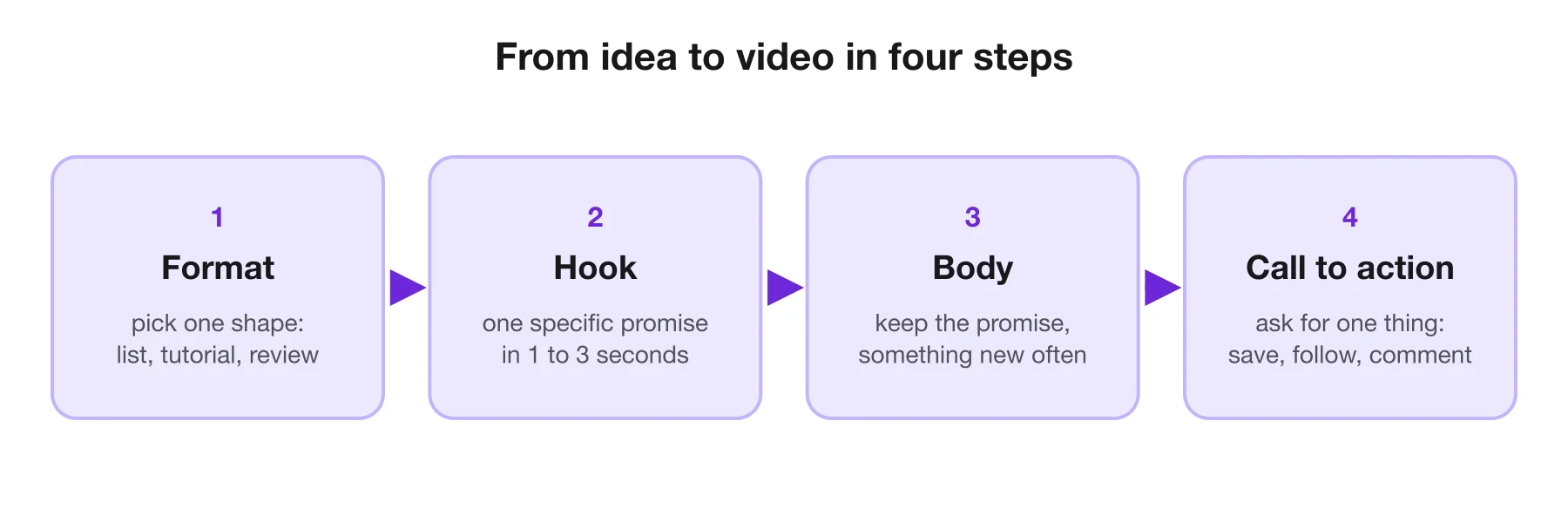
An idea is a topic. A script is the order in which a viewer meets it. The simplest structure for short-form video has three parts:
| Part | Length | What it does | Example for "a hidden phone setting" |
|---|---|---|---|
| Hook | 1 to 3 seconds | makes one specific promise | "Your phone has a setting that hides spam calls." |
| Body | 10 to 40 seconds | keeps the promise, step by step | open Settings, show the three taps |
| Call to action | 2 to 5 seconds | asks for one thing | "Save this before you forget where it is." |
Write the hook last. Once you know what the body shows, the hook is just the most interesting sentence you can say about it. If you cannot write that sentence, the idea is not ready to film.
Two checks help before you record. First, can you say what the viewer gets from the video in one line? Second, does something change on screen every few seconds? A static shot of one person talking can work, but only if the words keep moving.
The fastest way to learn structure is to study videos that already worked and ask what made them go viral. Take a viral TikTok in your niche, write down its first sentence, count how many seconds pass before the payoff, and note what the ending asks for. Do that for five videos and you will see the same shapes again and again.
Tools That Help You Find Ideas
ViralDrop
Best for: finding out why a video in your niche went viral, then writing your own version.
ViralDrop breaks a TikTok, Reel or Short down into its hook, structure and call to action, and can rewrite the script for your own product and audience. When you have no video to start from, Trends Research reads your niche across TikTok, Reels and Shorts and suggests what to film next. Tracking comes with every plan, so a competitor's breakout reaches your inbox as a ready-made idea.
- Pros: starts from real videos that worked; analysis, rewrite and trends in one place.
- Cons: it analyses and suggests; it does not film or edit.
- Price: an analysis costs 5 credits, a Trends Research run 20 credits; plans from $9 a month, and new accounts get free welcome credits.
TikTok Creator Search Insights
Best for: knowing what people search for on TikTok before you film.
Search for it inside the TikTok app, where TikTok offers it in select regions. It ranks the topics people look up most, by category or by the kind of videos you make, and a content-gap filter picks out the ones few creators have covered yet.
- Pros: official demand data; free; built into the app.
- Cons: topics only, not formats or scripts; not available everywhere.
- Price: free.
TikTok Creative Center
Best for: seeing which hashtags are rising this week in your country.
TikTok's own trend pages rank hashtags by posts and views for a region and period, with analytics for each one. It is built for advertisers, but anyone can browse the top of the list.
- Pros: official data; shows what is growing, not only what is big.
- Cons: logging in is needed to see more than the first rows; hashtags are a signal, not an idea.
- Price: free.
FAQ
What kind of videos should I make on TikTok?
Make videos that answer one question or show one result your audience cares about. Tutorials, before-and-afters, honest reviews and replies to comments are a good start, because each has a clear payoff viewers can see coming.
Which topic is best for TikTok?
The best topic is one you can post about many times without running out. A narrow niche, such as budget meal prep rather than cooking, makes it easier for viewers to know what they get when they follow you.
What videos do well on TikTok?
Videos that people watch to the end and share do well. That usually means a clear hook in the first seconds, something new on screen every few seconds, and a payoff that matches what the opening promised.
How many TikTok video ideas should I test at once?
Test three versions of one idea before you judge it. A single video can be lifted or sunk by timing, so three takes on the same topic with different hooks tell you far more than three unrelated videos.
Where can I find TikTok ideas that already work?
Look at the most-watched recent videos of accounts in your niche, TikTok's own Creator Search Insights, and the trending hashtags in the Creative Center. Then study why the best ones worked before you copy the format.
Sources
- TikTok Newsroom: Creator Search Insights — checked September 30, 2026
- TikTok Creative Center: trending hashtags — checked September 30, 2026
- TikTok Help Center: how TikTok recommends content — checked September 30, 2026
Keep reading
- How to Go Viral on TikTok How to go viral on TikTok in 2026: what TikTok says it rewards, why followers matter less than you think, and how to study the videos that worked.
- How the TikTok Algorithm Works in 2026 The TikTok algorithm ranks eligible videos by what you watch, share and skip. What TikTok says counts, what changed in 2026, and how to reset your feed.
- TikTok Hooks: 50 Opening Lines and Why They Work TikTok hooks for 2026: 50 opening lines sorted by the seven hook types, why each type holds viewers, and how to test a hook before you build a video on it.