What Makes a Video Go Viral
Published September 30, 2026 · Updated September 30, 2026 · 8 min read
Ask ten creators what makes a video go viral and you will hear about luck, hooks, trending sounds and posting at the right time. Some of that is true and some is folklore. Two kinds of evidence are more useful than anecdotes: research on why people share things, and what the platforms themselves say their recommendation systems look for. This guide puts the two side by side, platform by platform, using sources checked on September 30, 2026, and ends with a way to check why one specific video took off.
Check why a video went viral
Paste a public TikTok, Reel or Short and get its hook, structure and call to action.
What Makes a Video Go Viral: The Short Answer
A video goes viral when enough viewers finish it and pass it on, and the platform notices. People share what makes them feel awe, anger or anxiety, what surprises them, and what is useful enough to send to someone. Platforms then show a video that viewers watch through and share to more people who do not follow the creator.
The sharing half comes from research. Jonah Berger and Katherine Milkman studied nearly 7,000 New York Times articles and found that content evoking high-arousal emotions, such as awe, anger or anxiety, was shared more, while content evoking sadness, a low-arousal emotion, was shared less. Positive content was more viral than negative content overall, and content that was surprising, interesting or practically useful was shared more too.
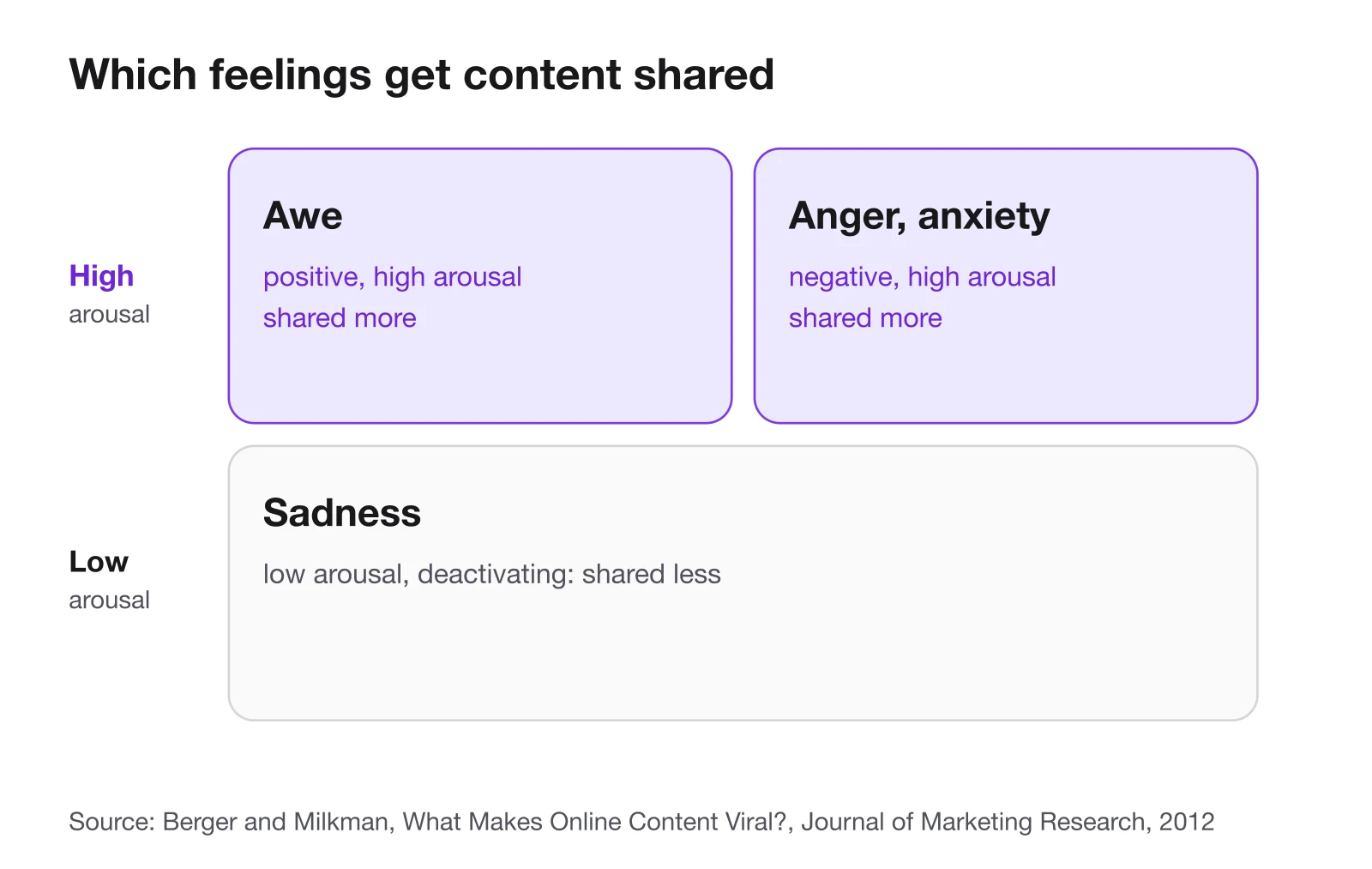
Their study was about news articles, not short videos, so treat it as a direction rather than a rule. It does explain a pattern anyone who scrolls has seen: videos that make you gasp, laugh or get annoyed travel further than ones that make you quietly sad.
Turned into video decisions, the findings suggest a few questions to ask before filming:
- Awe: is there a moment worth showing a friend, such as a result, a transformation or a scale nobody expected?
- Surprise: does the video overturn something the viewer believed? A claim that sounds wrong and then turns out right keeps people watching to see how.
- Usefulness: would someone save it or send it to a colleague because it solves a problem they have?
- Anger or anxiety: these spread too, which helps explain why outrage bait travels. It also tends to bring the wrong audience and comments you would rather not moderate, so use it with care.
A video that only informs, with no surprise and no feeling, can still do well in search. It rarely spreads on its own.
What Makes a Video Go Viral on TikTok
TikTok's Help Center says the For You feed is shaped by what you like, share, comment on, and watch in full or skip, by details of the video such as its sounds and hashtags, and, with less weight for most users, by device and account settings. It also says that interactions, including time spent watching, generally count for more than the other two.
Three consequences follow for anyone trying to reach new viewers on TikTok:
- Watching to the end is the signal to earn. A video people finish tells the system more than a video people like and leave.
- The audience is mostly strangers. A good video can reach people who do not follow the account, so the first seconds have to make sense to someone who has never seen the creator.
- Eligibility comes first. TikTok's current Community Guidelines keep unoriginal or reused material with nothing new, and content that tries to inflate likes or follows, out of the For You feed entirely.
For how the ranking works in more depth, and how to reset a feed that has gone wrong, see our guide to how the TikTok algorithm works.
What Makes a Video Go Viral on Instagram
Instagram says it does not run one algorithm but several, one for each part of the app. For Reels, where most of what people see comes from accounts they do not follow, the head of Instagram listed the most important predictions: how likely you are to reshare a Reel, watch it all the way through, like it, and go to its audio page, which Instagram treats as a sign you might make a Reel of your own.
Instagram also names what it shows less often in Reels:
| Instagram makes less visible | What to post instead |
|---|---|
| low-resolution Reels | the full-quality export |
| Reels with a watermark | the clean file, without another app's logo |
| muted Reels or Reels with borders | sound on, video filling the vertical frame |
| Reels that are mostly text | something to watch, with text as support |
| Reels already posted on Instagram | your own original, or a remix that adds something |
Originality is where Instagram changed its rules this year. On April 30, 2026 it extended the protections it introduced for Reels in 2024 to photos and carousels: accounts that mainly re-upload other people's work are no longer shown where Instagram recommends content. Where Instagram draws the line between reposting and repurposing is covered in our guide to repurposing video content.
What Makes a Video Go Viral on YouTube
YouTube's Help Center gives its recommendation system two goals: help each viewer find videos they want to watch, and maximise long-term viewer satisfaction. It learns from what viewers choose to watch, ignore or dismiss, how much of a video they watch, and what they like, share, comment on or say in surveys.
Two statements on that page cut through common myths. YouTube says it has not observed any evidence that publish time affects a video's long-term viewership. And it says the system uses fresh performance data for each video rather than relying on past results, so one experiment that does not land will not necessarily hold a channel back.
The same page gives creators practical advice that follows from those signals: a consistent title and thumbnail style so viewers recognise the channel at a glance, series and playlists that lead from one video to the next, and quality over a high number of uploads. It sums the approach up in one line: the algorithm follows the audience, so the question is not whether the algorithm likes a video but whether its viewers do.
Spot breakouts in your niche early
Competitor Watch compares each new post with the account's own normal.
What the Three Platforms Agree On
Read side by side, the three platforms' own descriptions overlap more than their different apps suggest.
| Signal | TikTok | Instagram Reels | YouTube |
|---|---|---|---|
| watching the whole video | watched in full or skipped | watched all the way through | how long and how much was watched |
| passing it on | shares | reshares | shares |
| other reactions | likes, comments | likes, going to the audio page | likes, dislikes, comments, surveys |
| content kept out of recommendations | unoriginal or reused material | reposts, watermarks, aggregators | not described on the page cited |
The common thread is that each platform watches what viewers do after the video starts, not what the creator claims about it. Follower count plays a small part at most: TikTok says it is not a direct factor, and Instagram lists it as one of several signals about the person who posted, after the viewer's own activity. Two of the three say plainly that they hold back reposted work.
What Changed in 2026
The YouTube change is the one that moves numbers people compare. TeamYouTube says creators will likely see their total view counts rise faster from August 24 onwards. A video that reads as a breakout on its view count alone may simply be counted differently than one from last year, so compare like with like.
How to Check Why a Specific Video Went Viral
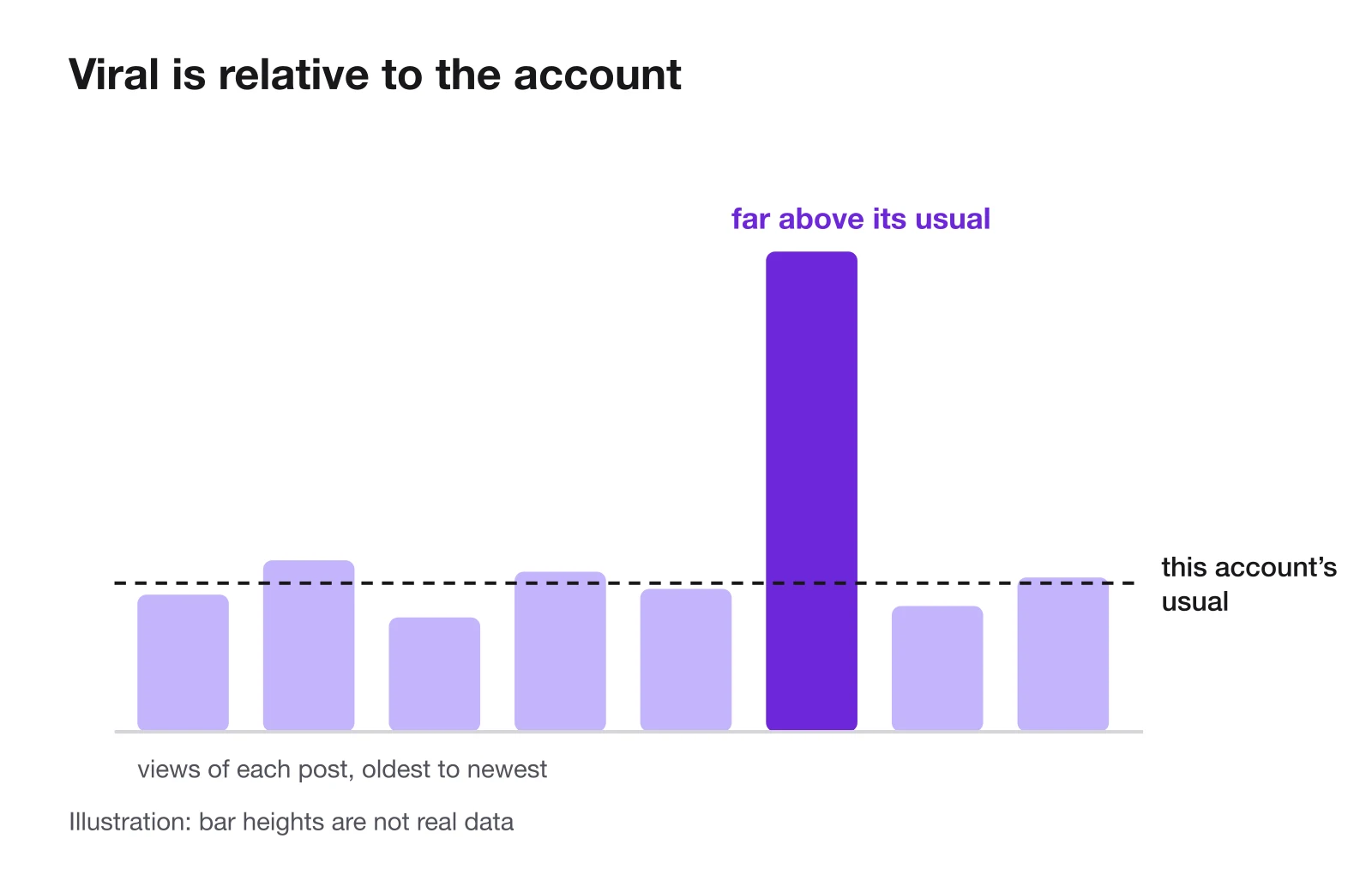
General rules explain categories. To learn from one video, you have to take it apart. Start by checking that it really was a breakout: compare its views with the same account's other recent posts of a similar length, not with the biggest channels in the niche.
Then look at four things in order:
- The opening. What does the viewer see and hear before they decide to stay?
- The structure. How is the middle divided, and how often does something new arrive?
- The feeling. Which reaction does it aim for: surprise, awe, a laugh, annoyance, or a problem solved?
- The ask. Does it end with a follow, a link, a question, or nothing?
Write the answers down for each video you study. After five or six breakouts in the same niche, the patterns repeat, and those patterns are a better brief for your next video than any general list of tips.
ViralDrop does this from a public TikTok, Instagram Reel or YouTube Short link. An analysis costs 5 credits and returns the key frames, the text on screen, a full transcript of the speech, and a breakdown of hook, body and call to action with an explanation of why the video performed. If you only need the words, a video transcript costs 2 credits for every started 10 minutes.
FAQ
How do you make a video go viral?
You cannot guarantee it, but you can raise the odds. Aim for a strong feeling or a genuinely useful payoff, make the first seconds clear to a stranger, keep the video original, and study breakouts in your niche before you film.
Is 10,000 views considered viral?
It depends on the account. For a creator who usually gets a few hundred views, 10,000 is a clear breakout. For a large channel it is below normal. Measure a video against its own account's recent average, not a fixed threshold.
Is 2 million views considered viral?
For almost any creator, yes: two million views means a video travelled far beyond its usual audience. For the biggest accounts it can be routine, so check the multiple against their other posts before calling it a breakout.
Does posting time decide whether a video goes viral?
Less than people think. YouTube says it has seen no evidence that publish time affects a video's long-term viewership, though posting when your audience is active can bring more views in the first hours. The video matters more than the clock.
Sources
- Berger and Milkman, What Makes Online Content Viral?, Journal of Marketing Research (2012) — checked September 30, 2026
- TikTok Help Center: how TikTok recommends content — checked September 30, 2026
- TikTok Community Guidelines: For You feed eligibility standards (effective September 24, 2026) — checked September 30, 2026
- Instagram: Instagram ranking explained (May 31, 2023) — checked September 30, 2026
- Instagram for Creators: rewarding original creators (April 30, 2026) — checked September 30, 2026
- YouTube Help: YouTube's recommendation system — checked September 30, 2026
- TeamYouTube: an update to how we count public views across YouTube (2026) — checked September 30, 2026
Take apart a video that went viral
Hook, structure, key frames and the reasons it performed, from one link.
Keep reading
- How to Go Viral on TikTok How to go viral on TikTok in 2026: what TikTok says it rewards, why followers matter less than you think, and how to study the videos that worked.
- How the TikTok Algorithm Works in 2026 The TikTok algorithm ranks eligible videos by what you watch, share and skip. What TikTok says counts, what changed in 2026, and how to reset your feed.
- TikTok Hooks: 50 Opening Lines and Why They Work TikTok hooks for 2026: 50 opening lines sorted by the seven hook types, why each type holds viewers, and how to test a hook before you build a video on it.