How to Go Viral on TikTok
Published September 30, 2026 · Updated September 30, 2026 · 9 min read
Everyone who posts on TikTok wants to know how to go viral on TikTok, and most of the advice online is either a list of tricks or a promise nobody can keep. There is no button for it. What there is, is a fairly clear picture from TikTok itself of what its For You feed rewards, plus a method anyone can use: find the videos in your niche that broke out, work out why, and make your own version. This guide covers both, using TikTok's own help pages and guidelines, checked on September 30, 2026.
Find out why a TikTok went viral
Paste a public link and see its hook, structure and call to action.
What Going Viral Means on TikTok
On TikTok, a video goes viral when the For You feed keeps showing it to people who have never heard of the creator, and those people keep watching. The more of them who finish, rewatch or share it, the more reason the feed has to keep offering it to others.
TikTok has never published a number that makes a video viral, and it would be odd if it had. Fifty thousand views is a life-changing week for an account that usually gets a few hundred, and a slow day for a large media brand. The useful definition is relative: a video went viral for this account when it did far better than this account's own usual.
That definition also tells you where to look for lessons. A small creator's breakout often teaches more than a celebrity's average post, because the video had to earn its reach on its own.
How to Go Viral on TikTok Without Followers
This is the question TikTok answers most directly. In its explanation of the For You feed, TikTok says that neither follower count nor whether the account has had previous high-performing videos is a direct factor in the recommendation system. A big account tends to collect more views because its followers see its posts, but the ranking of each video for each viewer does not start from the follower number.
So a first video from a brand-new account is not locked out. What it needs is what every video needs: people who see it have to watch it, and the Help Center lists liking, sharing, commenting, watching in full and skipping among the interactions that count. For an account with no audience yet, that means a few practical choices.
Pick one subject and stay on it. Content information such as sounds, captions and hashtags helps TikTok find viewers who might care. An account that posts about espresso one day and car repair the next makes that matching harder.
Make the video complete on its own. New viewers have no context about you, so a video that depends on having seen the previous one loses them.
Keep it original. TikTok's Creator Academy says unoriginal content may be removed from the For You feed, and counts content largely repurposed from another source without creative edits as unoriginal. Reposting someone else's viral clip is the one shortcut that closes the door.
Post regularly enough to learn. Every upload is a test. A new account has no history to compare against, so the first few dozen videos are how you find your own usual.
Hashtags to Go Viral on TikTok
Hashtags matter less than their reputation. TikTok's Help Center lists them next to sounds as content information, alongside the number of views and the country where a video was posted. That is useful: it helps the system understand what the video is about. It is not a lever that pushes a video out.
What that means in practice:
- Describe the video. A hashtag that names the topic, the product or the format helps the right viewers find it, including people who search for it.
- Skip the magic tags. No TikTok page cited here says that a particular tag such as #fyp gets a video onto the For You feed.
- Do not describe something else. A popular tag that has nothing to do with the video sends it to people who scroll past, and skipping is also a signal.
- Write the caption for people. The caption and the words on screen tell viewers what they are about to watch, which decides whether they stay.
There is no official ideal number of hashtags. If a guide gives you one, it is that writer's habit, and you can test it against your own results.
See when a competitor's video takes off
Competitor Watch checks their new posts twice a day and emails you about breakouts.
The First 3 Seconds
The opening of a video is where most viewers decide. TikTok says that finishing a longer video from beginning to end is a strong signal of interest, and the Help Center counts skipping among the interactions it learns from. A viewer who leaves in the first seconds never gets to the part of the video that was worth watching.
Here is a well-built opening, taken from a ViralDrop analysis of one of the example videos on this site, a YouTube Short about buying a business.
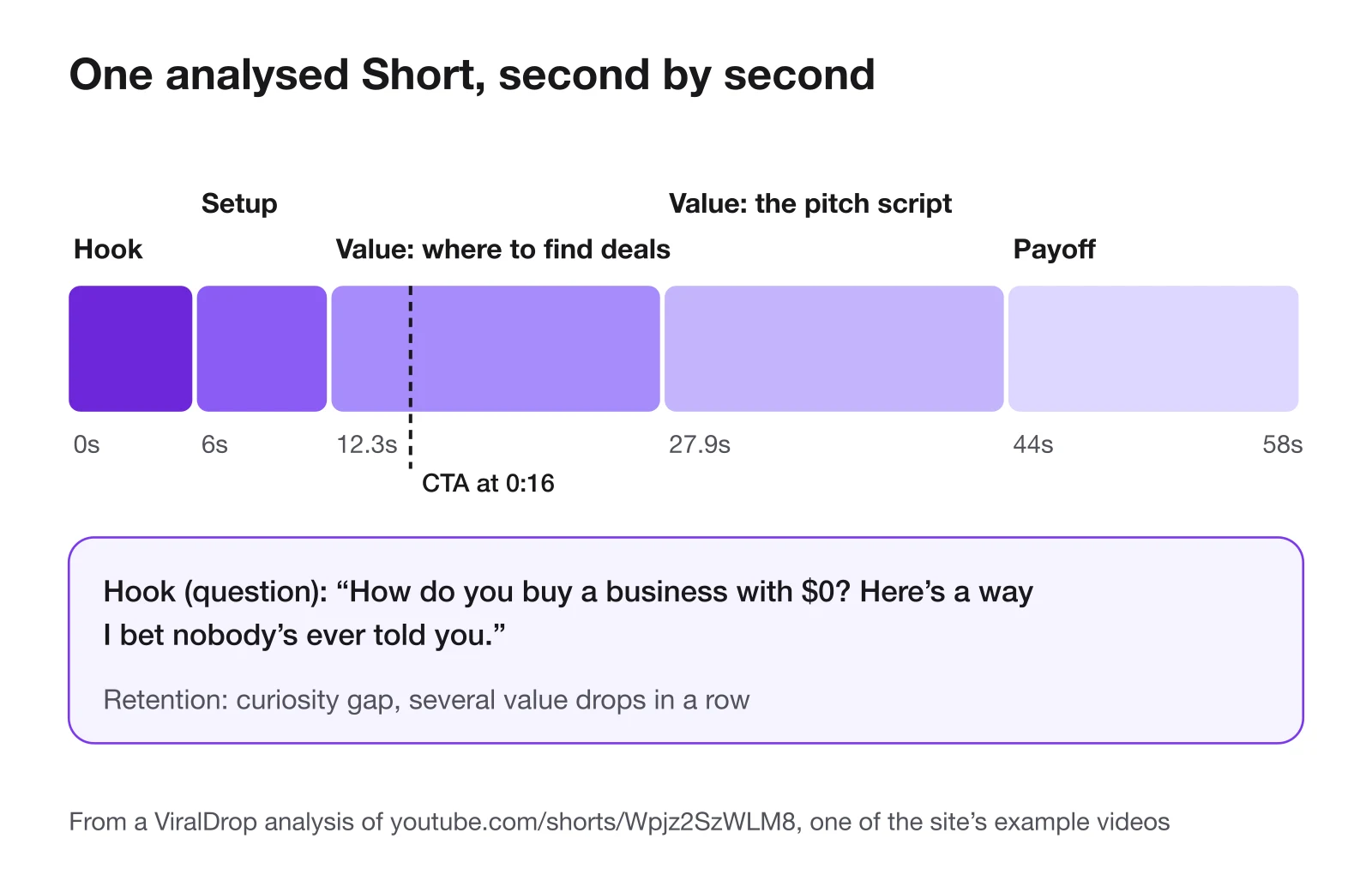
The analysis classed the hook as a question: "How do you buy a business with $0? Here's a way I bet nobody's ever told you." In six seconds it names a result people want, says it is unusual, and promises the method. Everything after that delivers on the promise, in concrete steps, and the analysis credits the retention to a curiosity gap and several separate value drops.
You do not need that exact formula. You need an opening that tells the viewer, straight away, what they get if they stay. For fifty opening lines sorted by type, see our guide to TikTok hooks.
Three Structures That Hold Viewers
A strong opening buys a few seconds. The middle has to keep paying. The three example videos on this site, each analysed by ViralDrop, hold attention in three different ways, and each is easy to borrow.
| Structure | Example video | How it keeps people watching |
|---|---|---|
| Step by step | How to Buy a Business With $0 | a curiosity gap, then one concrete step after another, including an exact pitch script |
| Numbered list | 3 Truths You Need to Accept | "rule number one, two, three" tells the viewer how much is left, and a recap closes it |
| Personal story | What Everyone Gets Wrong About Grief | a startling claim in the first line, then private detail that makes the viewer wait for the explanation |
The list video is a useful counterexample. Its analysis rated the hook as conventional, a standard numbered promise, and still credited the video's pull to the clear roadmap and to how much the three rules resonate. A plain opening can work when the structure behind it is easy to follow.
When you plan a video, pick the structure first. A tutorial wants steps, an opinion wants a list or a claim you then defend, and a lesson you learned the hard way wants a story. Then write the opening for that structure, not the other way round.
How to Study Videos That Already Went Viral
The most reliable way to get better at this is to take apart videos that already worked for an audience like yours. Watching them for fun does not count; the point is to write down what each one did.
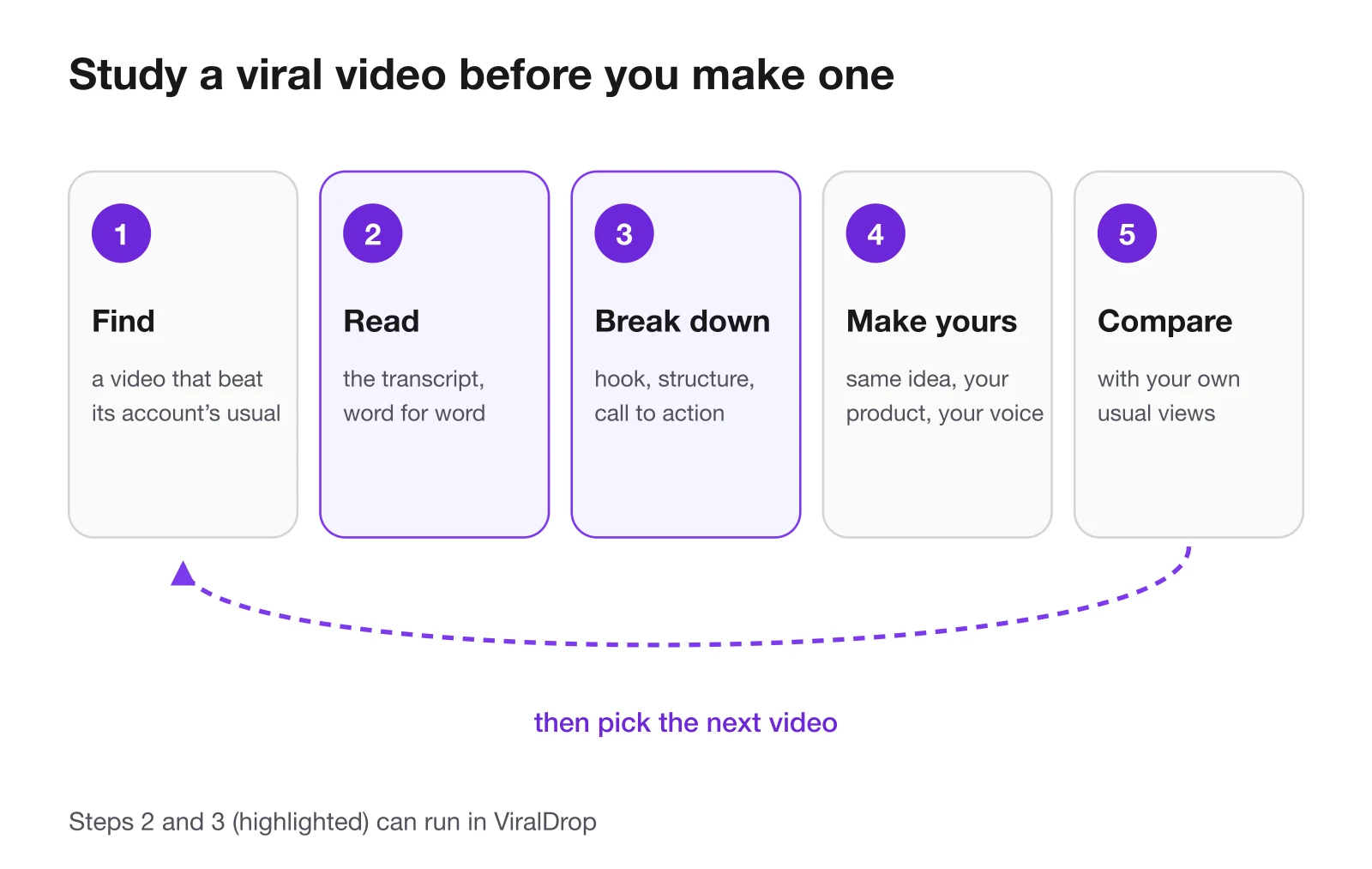
- Find the breakout. Look for a video that did far better than its own account's other posts, not simply the biggest video in the niche.
- Read the words. A TikTok transcript gives you the exact script with timestamps, so you can see how fast the creator gets to the point.
- Break it down. A ViralDrop analysis costs 5 credits and returns the hook, the structure, the key frames, the call to action and an explanation of why the video performed.
- Make your version. Keep the structure, change the subject to yours. The script rewrite tool does this from the same link and writes two scene-by-scene scripts for your product.
- Compare with your own usual. Judge the result against your account's normal, not against the video you studied.
Finding the breakouts is the slow part, and it is the part Competitor Watch does for you. It is in every ViralDrop plan, looks at the accounts you pick at 09:00 and 21:00 UTC, and sends an email when a new post runs well above that account's usual for its length. To see what is trending across a whole niche on TikTok, Reels and Shorts, a Trends Research report costs 20 credits.
What Changed in 2026
Both rules hit the shortcuts people reach for when growth is slow. Follow-for-follow requests and "like this if" posts are what the first one describes, and a reposted clip with nothing added is what the second one describes. Either can keep a post out of the For You feed, however good the rest of it is. How the feed ranks and filters videos, including the US retraining announced in January, is covered in our guide to how the TikTok algorithm works.
FAQ
How can a person go viral on TikTok?
By making a video that strangers watch to the end and share. Choose one subject, open with the payoff promised, keep the video original, and study breakouts in your niche. There is no guarantee, only better odds with every post.
How long do TikToks usually take to go viral?
There is no fixed timeline. Some videos take off within hours, others weeks later when a topic comes back. A quiet first day does not mean a rule was broken: TikTok analytics shows whether a post was made ineligible.
How many views do I need to go viral on TikTok?
No view count is official. What matters is the multiple: a video with ten times your usual views is a breakout for you, whatever the absolute number. Track your own average so you can recognise one when it happens.
Is it easy to go viral on TikTok?
Not reliably. TikTok does show videos to people who do not follow you and does not rank by follower count, which gives new accounts a real chance. Most videos still reach a modest audience, which is why creators treat each one as a test.
How to go viral on TikTok overnight?
You cannot plan it. A video can spread within a day when viewers finish and share it quickly, but buying followers or trading likes breaks TikTok's rules on fake engagement. Post often, open strong, and learn from each result.
Sources
- TikTok Newsroom: how TikTok recommends videos #ForYou (June 18, 2020) — checked September 30, 2026
- TikTok Help Center: how TikTok recommends content — checked September 30, 2026
- TikTok Community Guidelines: For You feed eligibility standards (effective September 24, 2026) — checked September 30, 2026
- TikTok Community Guidelines: integrity and authenticity — checked September 30, 2026
- TikTok Creator Academy: understanding the originality policy — checked September 30, 2026
Break down a viral TikTok
See the hook, the structure and why it performed, from one public link.
Keep reading
- How the TikTok Algorithm Works in 2026 The TikTok algorithm ranks eligible videos by what you watch, share and skip. What TikTok says counts, what changed in 2026, and how to reset your feed.
- TikTok Hooks: 50 Opening Lines and Why They Work TikTok hooks for 2026: 50 opening lines sorted by the seven hook types, why each type holds viewers, and how to test a hook before you build a video on it.
- TikTok Tools for Creators and Marketers The TikTok tools creators and marketers use in 2026 for research, editing, captions, scheduling and analytics, with prices checked on each official site.