TikTok Hooks: 50 Opening Lines and Why They Work
Published September 30, 2026 · Updated September 30, 2026 · 11 min read
TikTok hooks get more attention than any other part of a short video, and for a good reason. TikTok's help pages say that interactions such as the time spent watching a video generally weigh more heavily than other signals in its recommendations. A viewer who swipes away in the first second never reaches your point, however good it is, and the video loses the watch time it needs to go viral on TikTok.
Below are 50 opening lines, sorted by type, with a note on why each type works and when it backfires. Treat them as templates: swap in your niche, your product and your own words. Then read how to test a hook, and how to find the ones already working for accounts like yours.
See the Hook of Any Viral Video
Paste a TikTok, Reel or Short and get its hook, type and strength, with the structure after it.
What a TikTok Hook Is
A hook is everything the viewer gets before they decide to stay: the first spoken line, the first frame, and any caption on it. It does one job, which is to make the next ten seconds feel worth it. It does not have to explain the video. It has to open a question the video will answer.
A good hook is specific. "Here are some tips" promises nothing; "The one setting that doubled my battery life" promises one concrete thing. It is also honest. If the opening line says "three mistakes", the video should show three mistakes, in order, without a detour.
Three parts work together:
| Part | What it does | Example |
|---|---|---|
| Spoken line | states the promise | "Grief in many ways is like psychosis." |
| First frame | shows who is talking, or the result | the finished dish before the recipe |
| Caption | repeats the promise for people on mute | "NO ONE TELLS YOU THIS" |
The spoken line in that table is real: it is the opening of one of the example videos we break down later in this guide.
TikTok Hook Ideas by Type
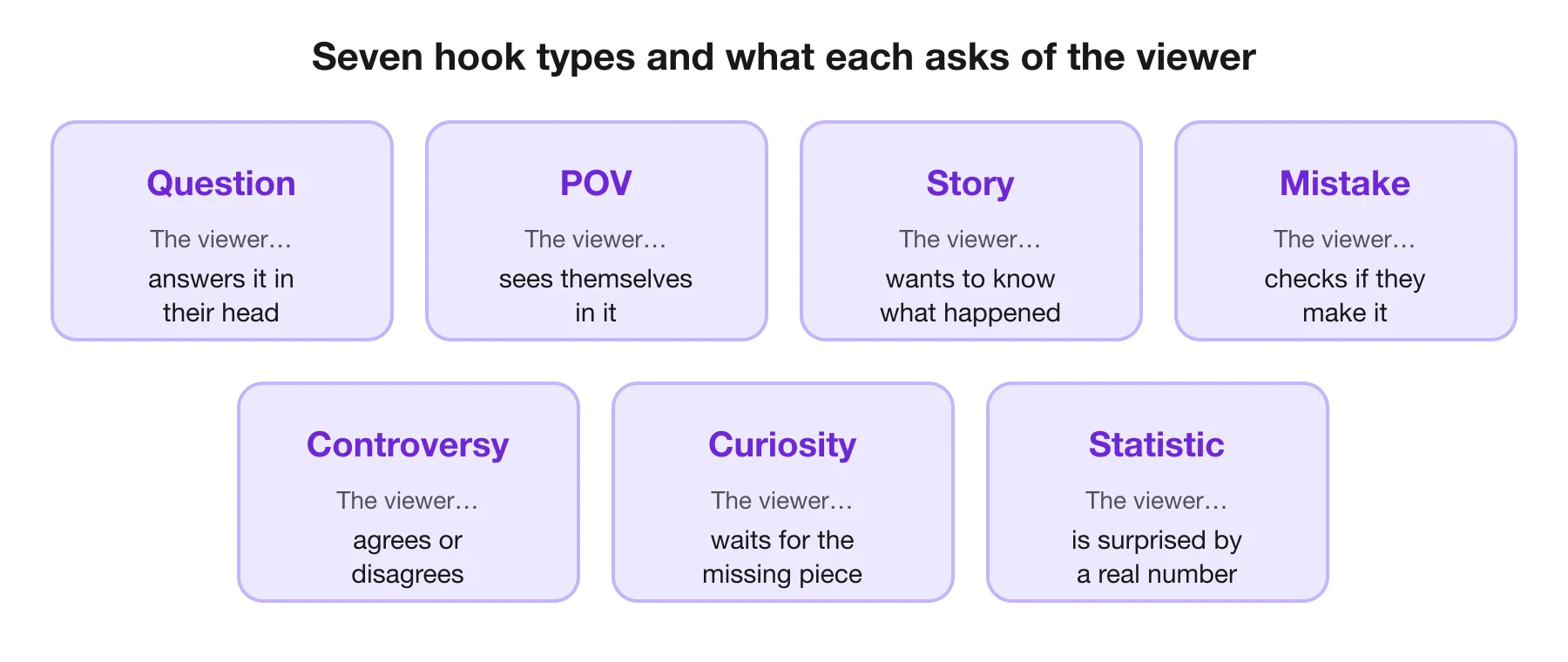
ViralDrop's analysis sorts each hook into one of seven types, or marks it as other. The 50 lines below use the same seven, so you can see which type your niche leans on and which one you have not tried. Replace the parts in brackets.
Question hooks
A question makes the viewer answer it in their head, and then want to check their answer. It works best when the viewer is not sure of the answer.
- "Why does nobody talk about [problem]?"
- "How do you [result] with [unexpectedly small resource]?"
- "Would you pay [price] for this?"
- "What would you do if [situation]?"
- "Is [common habit] actually hurting your [goal]?"
- "Which one would you pick: A or B?"
- "Did you know you can [surprising use] with [ordinary thing]?"
POV hooks
A POV puts the viewer inside a scene they recognise. It works when the scene is very specific to your audience.
- "POV: you just opened your first [thing] and have no idea what you are doing."
- "POV: your client asks for 'one small change' at 11 pm."
- "POV: you finally found the [product] that actually [does the thing]."
- "POV: it is your first week as a [job]."
- "POV: you tried [trend] so they don't have to."
- "POV: you are the friend who always [habit]."
- "POV: you open the app and see [unexpected result]."
Story hooks
A story starts in the middle. It works when the first line already contains a turn: something went wrong, or went much better than expected.
- "Last week I almost lost [thing] because of one email."
- "I quit [job] with [small amount] saved. Here is what happened."
- "My [relative] told me this at [age], and I ignored it for years."
- "This started as a joke and turned into [result]."
- "I spent [time] trying to [goal]. Only one thing worked."
- "A customer walked in and asked for something we had never made."
- "The worst advice I ever took came from [source]."
Mistake hooks
A mistake hook promises that the viewer will avoid a loss. It works when the mistake is common enough that the viewer suspects they are making it.
- "Stop doing this when you [activity]."
- "You are [doing task] wrong, and it is costing you [result]."
- "Three mistakes every beginner [role] makes."
- "I made this mistake for [time]. Please don't."
- "If your [thing] looks like this, you need to fix one setting."
- "The most expensive mistake I made in my first year of [activity]."
- "Don't buy [product] until you check this."
Controversy hooks
A controversy hook states an opinion that some viewers will disagree with. It works when you can back the opinion up in the same video. Without a payoff it reads as bait, and the comments will say so.
- "Unpopular opinion: [common advice] is wrong."
- "[Popular product] is overrated, and here is why."
- "Nobody needs [thing everybody buys]."
- "[Common goal] is the wrong goal."
- "This is going to annoy every [role] who watches it."
- "I don't think you should [popular habit] at all."
- "[Industry] doesn't want you to know how simple this is."
Curiosity hooks
A curiosity hook withholds one piece of information. It works when the gap is specific and the answer comes soon.
- "There are three things you need to accept about [topic]."
- "The last one surprised me the most."
- "I tested every [product type] under [price]. One was clearly better."
- "This is the only [tool] I use every single day."
- "Watch what happens when I [action]."
- "One change made our [metric] go up, and it wasn't the one I expected."
- "Here's what [expert role] does that nobody else does."
Statistic hooks
A statistic hook leads with a number. It works only when the number is real and you can say where it comes from; a made-up figure is the fastest way to lose trust.
- "[Number] out of [number] people [surprising fact], according to [source]."
- "I tracked every [thing] for [time]. Here are the numbers."
- "This [thing] costs [price], and it lasts [time]."
- "We posted [number] videos in [time]. Here is what we learned."
- "[Number] minutes a day is all it took to [result]."
- "It took [number] tries to get this right."
- "Our best video got [multiple] the views of our average one. This is what it did differently."
- "The average [thing] is [number]. Mine is [number]. Here is the gap."
Viral Video Hooks for Reels and Shorts
The same seven types work on Instagram Reels and YouTube Shorts, because the problem is the same: a viewer with a thumb on the screen. A few habits help a hook travel between the three apps:
- Say it and show it. Put the promise in the spoken line and in a caption on the first frame, so the hook works with and without sound.
- Keep the first frame clean. Leave room for each app's buttons and captions, which sit in different places on each platform.
- Open on the payoff when it is visual. A finished room, a plated dish or a before-and-after makes a stronger first frame than someone saying hello.
- Cut the greeting. "Hi guys, welcome back" spends the seconds the hook needs.
If you post the same video on all three, keep the hook identical at first. When one platform keeps viewers longer, change the opening only there, and you will learn what that audience responds to.
Break Down a Reel or Short
Paste a link and see the hook, the structure and the call to action, with timings.
Five Ways a Hook Backfires
A hook that holds viewers for three seconds and then loses them is worse than a quiet one, because it teaches your audience to scroll past you. These are the patterns that cause it most often:
- The promise is bigger than the video. "This will change your life" followed by a small tip feels like a trick, and viewers leave as soon as they notice.
- The payoff arrives too late. If the answer to the opening question comes in the last second, most people are gone before it. Deliver something every few seconds.
- The first frame contradicts the line. Saying "look at this result" over a shot of your face makes the viewer wait for a picture that is not there.
- The hook is about you, not them. "Today I want to talk about" puts the creator first. "You are losing clients because of one email" puts the viewer first.
- Every video uses the same opening. Your regular viewers learn the pattern and stop reacting to it. Rotate types, even when one is working.
How to Test a Hook
Hooks are guesses until you test them. The test is simple, but it needs discipline: change one thing, keep everything else.
- Pick one video idea, for example from these TikTok video ideas by format and niche. Keep the body and the ending the same.
- Write two or three openings of different types. For example a question and a mistake hook.
- Post them apart. Leave at least a few days between versions, so they do not compete for the same viewers.
- Compare how long people watch. TikTok Studio's analytics report how each post performs, so you can put the versions side by side.
- Keep the winner's type. Use it on the next three ideas before you conclude anything.
A single test proves little, because one video can be lifted by a trend or sunk by bad timing. A pattern across several ideas is what tells you that a hook type suits your audience.
How to Find Hooks That Already Work
Writing hooks from scratch is slower than studying the ones that already hold viewers in your niche. Tracking your TikTok competitors puts those videos in front of you as they take off. You can do it by hand: open a viral video, write down its first sentence, and note what the first frame shows. A tool does the same thing faster and on more videos.
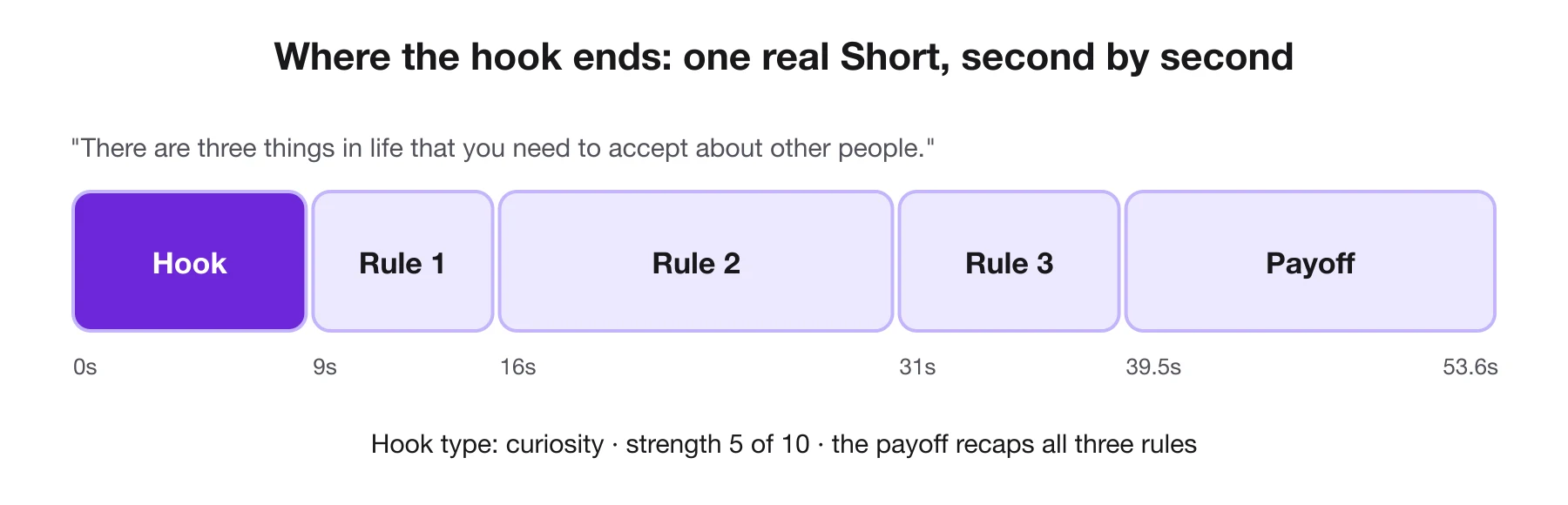
Here is what ViralDrop's analysis found in three Shorts from our public example set:
| Video | Opening line | Hook type | Strength |
|---|---|---|---|
| What everyone gets wrong about grief | "Grief in many ways is like psychosis." | controversy | 8 of 10 |
| How to buy a business with $0 | "How do you buy a business with $0? Here's a way I bet nobody's ever told you." | question | 7 of 10 |
| 3 truths you need to accept | "There are three things in life that you need to accept about other people." | curiosity | 5 of 10 |
The reasons matter more than the scores. The grief opening scored highest because it reframes a universal experience in one bold sentence. The business opening pairs a high-stakes promise with a challenge to what the viewer believes. The third is a competent numbered promise, but it uses familiar phrasing and has no visual surprise, so the analysis rated it lower even though the video did well.
These tools help you collect hooks at scale:
ViralDrop
Best for: studying why a specific viral video worked, hook first.
Paste a link from TikTok, Instagram Reels or YouTube and the analysis returns the hook's text, its type and a strength score with a reason, followed by the video's structure, retention tactics and call to action. A script rewriter can then turn that structure into a script for your own product. It reads the speech and the text on screen. An analysis costs 5 credits, and new accounts get free welcome credits to try it. Competitor tracking is included in every plan: add the accounts you study and get an email when one of their posts takes off, so you see new hooks while they are still working.
- Pros: real hooks from real videos, with a reason for each; works across three platforms; up to 20 videos at once.
- Cons: it analyses videos you choose; it does not write hooks for a topic you have not seen yet.
- Price: plans from $9 a month; free welcome credits for new accounts.
TikTok Creative Center: Top Ads
Best for: seeing how advertisers open their best-performing ads.
TikTok's own library of high-performing auction ads, filterable by region, objective and period. Each ad shows likes, a CTR band and a budget level. The first seconds of a paid ad are a hook under pressure, so it is a useful place to study openings.
- Pros: official data from TikTok; free to browse.
- Cons: ads only, and only those the advertiser authorised; logging in is needed to see them all.
- Price: free.
TikTok Creator Search Insights
Best for: turning what people search for into the question your hook asks.
A tool inside the TikTok app, available in select regions, that lists topics people search for often, sorted by category or by what you post. Its content gap filter shows topics searched often but covered by few videos, which make natural question hooks.
- Pros: built into TikTok; shows demand before you film.
- Cons: topics, not hooks; available in select regions only.
- Price: free.
FAQ
What's a hook on TikTok?
A hook is the opening of a TikTok, usually the first one to three seconds. It includes the first line you say, the first frame and any caption on it, and its job is to make the viewer want to see what comes next.
What are good hook examples?
Good hooks are specific and honest. "Stop doing this when you edit on your phone" and "Grief in many ways is like psychosis" both promise one concrete thing that the video then delivers. Vague openings like "some tips for you" rarely hold anyone.
What are the 7 types of hooks?
The seven types most short-form hooks fall into are question, POV, story, mistake, controversy, curiosity and statistic. They are the same types ViralDrop's analysis uses when it labels the hook of a video, which makes it easy to compare them.
What are the best viral hooks for 2026?
There is no single best line, because a hook that works in cooking can fall flat in finance. The strongest approach in 2026 is to study what already holds viewers in your own niche, then adapt the type rather than copying the words.
How long should a TikTok hook be?
Aim for one sentence that fits in the first three seconds. If the promise needs two sentences, the second should raise the stakes, not explain the first. Anything longer turns the hook into an introduction that viewers skip.
Can I reuse another creator's hook?
You can reuse a hook's type and structure, which nobody owns. Copying someone's exact words and delivery is a different matter: it reads as a copy to viewers who follow both of you, and it gives them no reason to pick you.
Sources
- TikTok Help Center: how TikTok recommends content — checked September 30, 2026
- TikTok Newsroom: TikTok Studio — checked September 30, 2026
- TikTok Newsroom: Creator Search Insights — checked September 30, 2026
- TikTok Creative Center: Top Ads — checked September 30, 2026
Keep reading
- How to Go Viral on TikTok How to go viral on TikTok in 2026: what TikTok says it rewards, why followers matter less than you think, and how to study the videos that worked.
- How the TikTok Algorithm Works in 2026 The TikTok algorithm ranks eligible videos by what you watch, share and skip. What TikTok says counts, what changed in 2026, and how to reset your feed.
- TikTok Tools for Creators and Marketers The TikTok tools creators and marketers use in 2026 for research, editing, captions, scheduling and analytics, with prices checked on each official site.